داستان کوتاه / شیخ عقلالتعطیلShort Stories / Sheikh Aql-al-Tatil
The Man Who Declared Thinking an Act of Unbelief
Avicenna and Farabi were still alive in their books. Their works were read in schools and copied in the market, and young readers found new questions in their pages.
- 3 min read
Drag a page corner to turn it, or tap the page
Avicenna and Farabi were still alive in their books.
Their works were read in schools and copied in the market, and young readers found new questions in their pages.
That was what kept Sheikh Aql-al-Tatil awake at night.
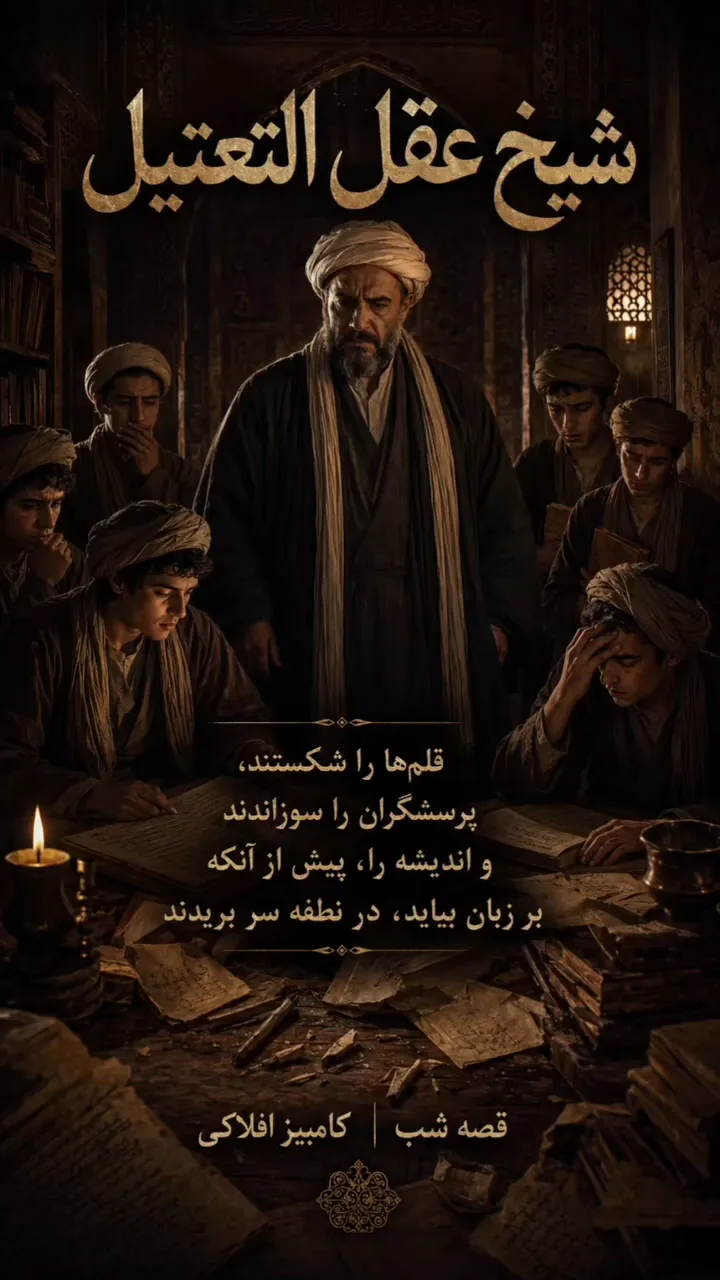
One morning he climbed the pulpit.
“People! The enemy does not always come with a sword. Sometimes it hides in a book.”
“What is this enemy called, Sheikh?” a disciple asked.
“Knowledge that draws you away from God.”
A murmur spread through the mosque.
“Farabi said people could discover truth through reason. Avicenna said everything has a cause. Disease has a cause. Rain has a cause. Even the movement of the stars follows calculations and laws.”
He struck the pulpit with his fist.
“If everything has a cause, what becomes of God and revelation? If a physician discovers the cause of illness, people will no longer come to our shop for a cure.”
The next day, the books of Farabi and Avicenna were brought into the town square.
Their books, rather than the men themselves.
“Today we put these two dead men on trial,” the sheikh told the crowd.
“Sheikh, the dead cannot speak,” said Mirza Sheyda, standing at the edge of the square.
“A dead man who has books is more dangerous than a thousand living men,” the sheikh replied.
He held up Avicenna’s book and read,
“A physician must recognize the symptoms of a disease, identify its cause, and prescribe the appropriate medicine.”
He closed the book.
“Did you hear? Not even a mention of charms or prayers.”
The crowd laughed.
But the town’s old physician did not.
“Sheikh, is it wrong to understand what causes a disease?”
“No… provided the cause is whatever I say it is.”
“And what if you are mistaken?”
The square fell silent.
The sheikh stared at him for a few moments.
“That very question is proof of your unbelief.”
A decree was issued that day.
Henceforth, anyone who asked “why” too often must repent.
Anyone who spoke of the causes of illness would be accused of interfering in God’s work.
Anyone who calculated the movements of the stars must prove he had no intention of commanding the heavens.
Within months, the old physician left town.
The astronomer broke his astrolabe.
The geometry teacher closed his classroom.
And the pupils learned to look around before asking a question.
Years passed.
One day a terrible disease struck the town.
People burned with fever. Children grew weak. No cure could be found.
Everyone went to the sheikh.
He ordered a thousand candles lit, pots beaten, and prayers written on the doors of houses.
But the disease did not leave.
The sheikh himself fell ill.
He had a fever. His body shook.
“Send for the physician,” he said weakly.
“There are no physicians left, Sheikh. You expelled the last one for asking what caused the disease.”
“Then bring Avicenna’s book.”
“You burned that in the square yourself.”
The sheikh fell silent.
Then, for the first time in his life, he asked,
“Why?”
But in the whole town, no one remained who was permitted to answer a “why.”
Sheikh Aql-al-Tatil died.
His way of thinking lived on.
Whenever someone asked a new question, somebody would say,
“Be quiet… That question smells of unbelief.”
And that was how the light of knowledge went out. It happened through teaching people to fear approaching the light.