داستان کوتاه / تاریخیShort Stories / Historical
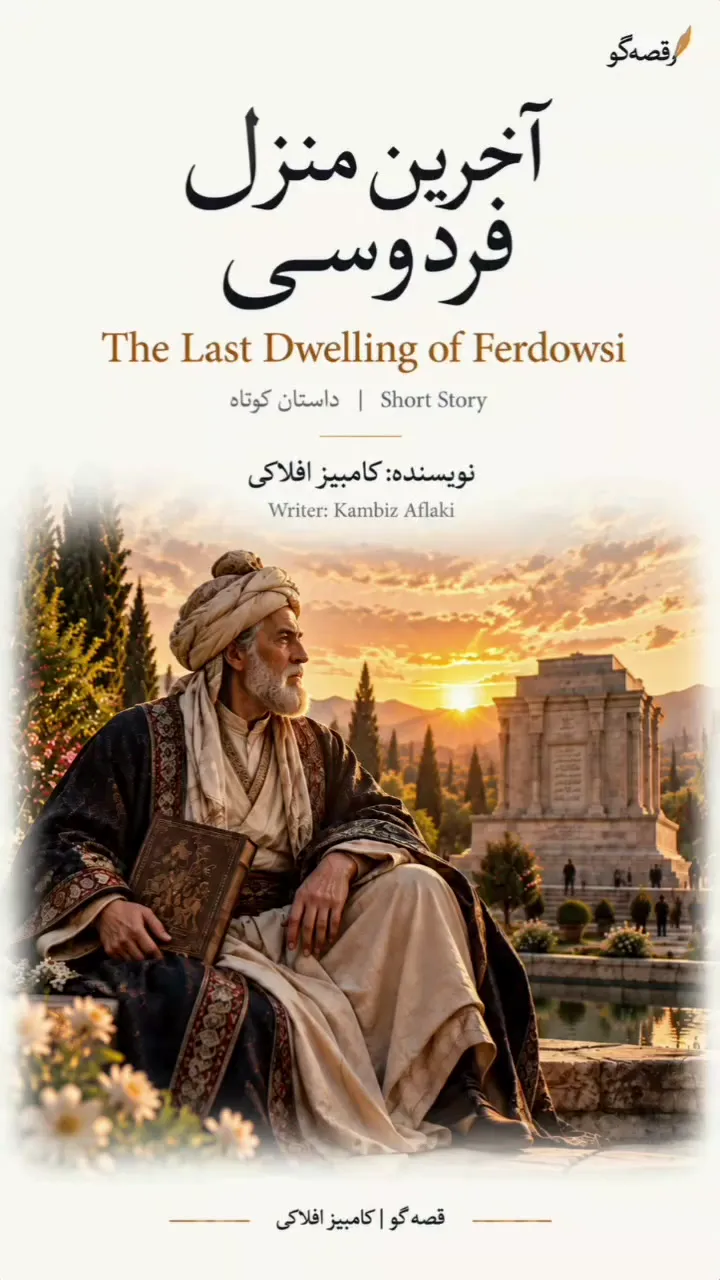
The Last Dwelling of Ferdowsi
Ferdowsi lay upon his bed, each breath fainter and shorter than the one before. His daughter sat beside him, clasping her father’s hands tightly within her own.
- 3 min read
- With video
Drag a page corner to turn it, or tap the page
Ferdowsi lay upon his bed, each breath fainter and shorter than the one before.
His daughter sat beside him, clasping her father’s hands tightly within her own.
The old man opened his eyes.
He said:
“Have you watered the garden?”
A bitter smile touched his daughter’s face.
“Even now, are you still troubled for the garden?”
Ferdowsi answered softly:
“In life’s final breaths, it is the simplest things for which a man’s heart aches most.”
For a while, he remained silent.
Then he lifted his gaze to the ceiling and said:
“For years I have told myself: if the Shahnameh endures, that is enough.”
His daughter asked:
“And now?”
Her father looked upon her.
“Even now, I say the same.”
She tightened her grasp upon his hand.
“Father… the people will not forget you.”
A faint smile passed across Ferdowsi’s face.
“I know. A work worthy of enduring will, in time, find its own path.”
He lingered a moment, then added:
“I do not believe my name shall ever be severed from the Shahnameh. So long as the Shahnameh endures, so too shall my name.”
Then, gently, he closed his eyes.
By dawn, word of Ferdowsi’s death had swept through Tus.
The people gathered.
Upon their shoulders they bore his body toward the burial ground.
Before they had reached the grave, a man stepped forth.
He was a Muslim preacher of that very city.
He said:
“This man shall not be laid to rest here.”
A murmur rippled through the gathered crowd.
One voice asked:
“Why?”
The man replied:
“He was a Rafizi. There is no place for him among the graves of Muslims.”
Ferdowsi’s daughter stepped forward.
Her eyes were crimson with weeping.
She said:
“This man bore the name of God upon his lips throughout his life. Who appointed you to sit in judgment in God’s stead?”
The man turned his face away.
He said:
“I have spoken. He shall not be buried here.”
For a few lingering breaths, the daughter gazed upon her father’s still form.
Then, quietly, she said:
“Take him back.”
“The God of the Shahnameh will have a better resting place for him.”
They bore Ferdowsi’s body away from the burial ground.
Through the winding lanes of Tus they carried him, until at last they reached his own garden.
The very garden through which he had walked for so many years.
The very trees beneath whose shade he had woven the verses of the Shahnameh.
His daughter sat beside her father.
She gathered a handful of earth into her palm.
She looked upon him and said:
“Do you see, Father?
Even the Shahnameh and this garden could not bear to be parted from you.”
That day, one man denied Ferdowsi his rest among the graves of the city.
Today, even that man’s name has not come down to us with certainty.
Perhaps no grave remains of him, no trace, no memory.
Yet a thousand years on, the name and renown of Ferdowsi still live upon the tongues of humankind.
And while the world yet stands, his name shall shine.
 Short Stories / Historical · 2 min read
Kept Alive by Love