داستان کوتاه / تاریخیShort Stories / Historical
Rage and Bread
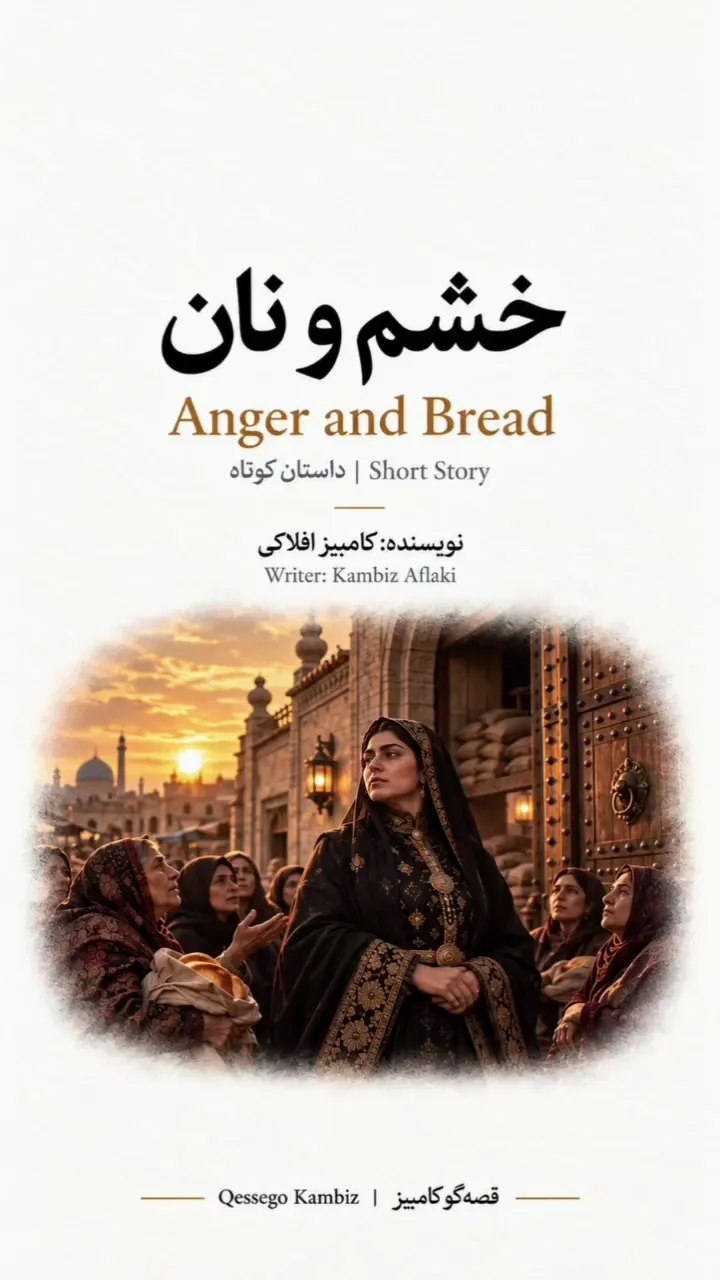
Tabriz, late Qajar era The granary door was still shut when the little girl collapsed from hunger onto the cobblestones.
- 3 min read
- With video
Drag a page corner to turn it, or tap the page
Tabriz, late Qajar era
The granary door was still shut when the little girl collapsed from hunger onto the cobblestones.
Her mother gathered her into her arms and called her name, but the girl only blinked. The woman cried out to the crowd:
"Some bread! For God's sake, just a piece of bread!"
Behind the towering doors of the home of Nezam ol-Olama, a wealthy and influential cleric of Tabriz, the smell of wheat seeped through the gaps between the wooden planks.
On one side of the wall, the granaries were full. On the other, people stood with empty stomachs.
Zeynab Pasha stepped forward from among the women. She had tied her chador around her waist and held a wooden stick in her hand.
She looked at the little girl, then at the guard.
"Open the door."
The man placed his hand on his rifle.
"It's not mine to open."
"Then go and fetch its owner. Tell him the mothers have nothing left to put in their cooking pots."
The guard laughed.
"You women, go back home."
Zeynab took a step forward.
"Home? Where our children fall asleep hungry?"
The man raised his rifle. The crowd drew back. Even the sounds of the bazaar seemed to fall silent.
Zeynab did not move.
Suddenly, an old woman shouted from behind her:
"Strike! How many times can a person die of hunger?"
A stone struck the door. Then another.
The guard fired. A scream rang out, and the women scattered.
Zeynab pressed herself against the wall. A woman had fallen beside her, her hand covered in blood.
Zeynab bent down and pressed the woman's headscarf against the wound.
"Look at me. Don't close your eyes."
Then she looked up. The guard was reloading his rifle.
Zeynab rose to her feet.
"Don't let them fire again!"
The women rushed at the guards. Wooden sticks swung through the air. Several guards fell beneath the blows, while the others retreated.
Zeynab shouted:
"Break down the door!"
Sticks pounded against the wooden planks. Several women threw their shoulders against the door. The hinges gave way, and the granary opened wide, releasing the strong smell of wheat.
At first, no one moved.
All those sacks, all that wheat, just beyond a wall where children had been left to go hungry.
Zeynab opened one of the sacks.
Behind the crowd, more mothers were arriving, empty-handed, with children too exhausted even to cry.
That night, Nezam ol-Olama and his family fled. But their escape did nothing to extinguish the flames of the people's anger.
Hunger was no longer merely the pain of empty stomachs. It had turned into the fury of people who watched their children go hungry day after day, while behind the high walls of wealthy homes, granaries stood full of wheat.
The following day, the furious crowd stormed his home. They broke down the doors, looted his possessions, and left in ruins a house that had once stood as a symbol of wealth and power.
No one listened to calls for calm anymore.
People who had spent months begging for a single loaf of bread were now answering with sticks and stones.
Hunger alone does not give birth to violence. But when it is joined by humiliation, inequality, and the indifference of those in power, it can drive anger to the point of explosion.
That day, the people had taken to the streets for bread. But they returned home carrying an anger that was no longer just about bread.
 Short Stories / Historical · 2 min read
Kept Alive by Love